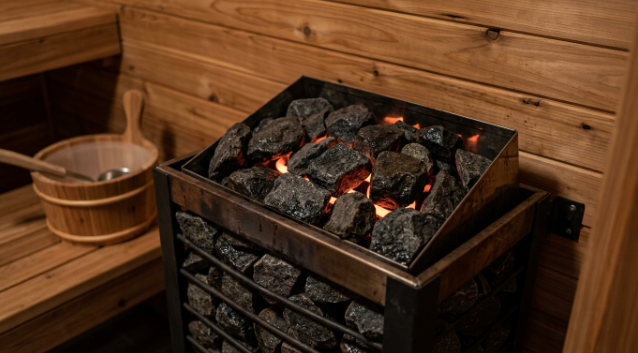
A sauna heater for a small space, a converted closet, a corner of a bathroom, or a compact backyard cabin under 70 cubic feet, should be sized to roughly 2 to 3.5 kilowatts using the standard guide of one kilowatt per 45 to 60 cubic feet, and it should fit the room’s electrical reality rather than assume a dedicated 240-volt circuit is available. The heater’s footprint and required clearance matter as much as its wattage, since a unit that technically fits on paper can still make a tight room unusable if the guard rail eats up half the available floor space.
How Small Is Too Small for a Sauna Heater?
Most manufacturers publish a minimum room size for each heater model, and going below it is not just a comfort issue, it is a safety one, since an undersized room cannot maintain the clearance the guard rail is built around. A converted closet or a corner of an existing room can work well down to roughly 30 to 40 cubic feet with the smallest heaters on the market, but anything tighter than that struggles to fit both a bench and the required clearance around the unit. Measuring the actual usable cubic footage, ceiling height included, before shopping for a heater avoids the common mistake of buying a unit and only then discovering the room cannot legally or safely house it.
Does a Small Room Really Need Less Clearance?
No, and this trips up more small-space buyers than any other spec. Clearance requirements come from the heater’s surface temperature, which does not change based on room size, so a two-person cabin and a tight closet conversion need the same number of inches between the guard rail and any bench, wall, or towel hook. In a small room this clearance takes up a proportionally larger share of the available floor space, which is exactly why heater footprint, not just wattage, deserves attention when shopping for a compact build. A heater with a narrow, tall profile often fits a tight corner better than a wide one with the same kilowatt rating.
What Electrical Setup Actually Works in a Small Space?
Small spaces do not automatically mean simpler electrical work. Heaters up to roughly 3 kilowatts often run on a standard 120-volt, 15 or 20-amp household circuit, which is genuinely easier to install in an apartment or a room without existing 240-volt capacity. Push past about 3.5 to 4.5 kilowatts, though, and a dedicated 240-volt circuit is typically required regardless of how small the room is, since the electrical code cares about the heater’s draw, not the cabin’s square footage. Renters and apartment dwellers in particular should confirm what the building allows before ordering, since a dedicated circuit often is not an option in a rented unit at all.
Infrared Panels or a Compact Traditional Heater?
Infrared panels mount flat against a wall and need only a few inches of clearance in front, which frees up floor space a freestanding rock-based heater cannot match in a tight room. A compact traditional heater delivers the higher heat and steam option many users prefer, but its guard rail extends outward on multiple sides, effectively shrinking the usable floor area in a small cabin more than its footprint alone suggests. For a genuinely tight space, this clearance difference often matters more than the difference in heat style, and it is worth measuring both options against the actual room dimensions rather than comparing kilowatt ratings side by side.
What Should a Small-Space Buyer Check Before Ordering?
Confirm the room’s real cubic footage, the heater’s minimum room size rating, the clearance dimensions on all sides of the guard rail, and whether the household’s existing electrical setup matches the heater’s voltage requirement. Compact heaters built specifically for small rooms are sold by most major brands, and pricing for units in this size class often runs lower than family-cabin heaters simply because they use less material and a smaller element. Shoppers comparing options for a tight space can look at Sweat Decks alongside other retailers to compare wattage, footprint, and price across the smaller end of the range before settling on a model.
Does Ceiling Height Matter More in a Small Room?
Yes, disproportionately so. A converted closet or bathroom corner often has a standard eight-foot ceiling, which adds more cubic footage than the same floor area with a lower drop ceiling, and that difference can push a heater sizing calculation into the next kilowatt bracket even though the footprint on the floor looks identical to a smaller room. Where possible, dropping a ceiling to around seven feet inside the sauna itself, a common trick in tight conversions, both trims the cubic footage the heater has to fill and keeps heat from stratifying uselessly near a ceiling nobody’s head reaches. This single adjustment sometimes allows a smaller, cheaper heater to do the job a larger, more expensive one would otherwise need to cover.
What Does the Research Say About Sessions in a Compact Setup?
The health associations tied to sauna use do not change based on cabin size, since they track the heat exposure itself rather than the room’s dimensions. A 2023 review in Mayo Clinic Proceedings examined whether pairing regular sauna use with other lifestyle habits produced additional associations with health outcomes. An earlier 2018 review in the same journal summarized cardiovascular associations across multiple cohort studies of frequent sauna bathing. A physiology review in the American Journal of Physiology described how the body responds to repeated heat exposure regardless of the size of the space it happens in. These remain population-level associations, not proof of an outcome for any one household, small space or not.
Frequently Asked Questions
What size sauna heater works for a small closet or bathroom conversion? A tightly sealed space under 70 cubic feet usually needs about 2 to 3.5 kilowatts, using the guide of one kilowatt per 45 to 60 cubic feet in a well-insulated room.
Can a small sauna heater run on a standard household outlet? Many heaters under 3 kilowatts, along with most infrared panels, are designed for a standard 120-volt circuit. Above roughly 3 to 4.5 kilowatts typically needs a dedicated 240-volt circuit.
Do small spaces need less clearance around a sauna heater? No. Clearance is set by surface temperature, not room size, so a small cabin needs the same clearance as a large one, which limits how tightly a heater fits into a corner.
Is infrared a better choice than a traditional heater in a tight space? Often yes, mainly because panels mount flat against a wall and need less floor clearance than a freestanding heater with a guard rail on multiple sides.
References
- Does the Combination of Finnish Sauna Bathing and Other Lifestyle Factors Confer Additional Health Benefits? A Review of the Evidence, Mayo Clinic Proceedings, 2023
- Cardiovascular and Other Health Benefits of Sauna Bathing: A Review of the Evidence, Mayo Clinic Proceedings, 2018
- Effects of heat and cold on health, with special reference to Finnish sauna bathing, American Journal of Physiology, 2018
By Sofia Bramante